M.K. Goth · The books
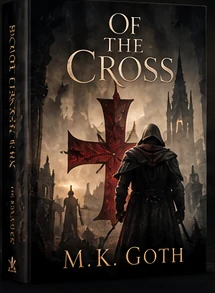
Of the Cross
What if a letter from a dead monk and a journal discovered in an abandoned keep could unravel everything we believe about history?
An account reconstructed from forgotten manuscripts, hidden archives, and the confessions of men who carried terrible knowledge to their graves. A history the powerful would dismiss as fiction—and some might prefer never to be read.
“I have written what I have found. Would that I had found less.”
An historical mystery at the boundary of faith, power, and things best left buried. Enter the world of Of the Cross through the words of the man who first assembled its forbidden history.Read the complete letter
The Last Testament of a Servant of God
To my Reverend Brothers of the Chapter,
May the grace of Our Lord Jesus Christ, the mercy of the Blessed Virgin, and the peace of the Holy Spirit be with you always.
I write these words in the waning days of my life, knowing that they may well be the last I shall set upon parchment. My hand has grown unsteady with age, though I confess it is not age alone that causes it to tremble.
For many years I have laboured to assemble the account which accompanies this letter. I have searched the archives of our Holy Church, examined manuscripts long hidden from the eyes of men, and heard the confessions of those who carried terrible knowledge to their graves. I have followed accounts obscured by time, altered by fearful hands, and, I must now believe, deliberately concealed.
What follows is the truth of the Poor Fellow-Soldiers of Christ and of the Temple of Solomon, insofar as God has permitted me to discover it.
I do not claim infallibility. Such certainty belongs to God alone. There may be errors of recollection, omissions born of ignorance, and matters which even now remain beyond my understanding. Yet I swear before Almighty God, upon the Holy Scriptures and in the full knowledge that I must one day answer for every word, that I have neither knowingly embellished these accounts nor concealed that which I believe to be true.
I have written what I have found. Would that I had found less.
The history of the Temple is not as we have been taught. Neither its glories nor its sins can be measured solely by the chronicles which have survived. Beneath those histories lies another, older and infinitely more terrible, its truths obscured by the passage of years, the ambitions of men, and perhaps even the misguided convictions of those who believed that silence was itself an act of mercy.
I had once believed that truth was a light before which all darkness must retreat. I have since learned that there are those who dwell within the darkness, and who have grown most comfortable there.
I believe I am watched. There are footsteps beyond my door that fall silent when I cease my prayers. There are faces among the congregation that I have seen too often and yet do not know. Twice have I found the contents of my chamber disturbed.
Perhaps some of these things may be attributed to the fears of an old man. I have considered this in prayer, and I pray still that it may be so. Yet I can no longer dismiss them all.
I do not know whether those who observe me serve men of the Church, enemies of the Church, or something for which I have no proper name. I know only that others who possessed fragments of this history have disappeared, and that I have lived longer than prudence should have allowed.
I believe my remaining days are few. This no longer troubles me as once it might have done. I am an old man. My body has become a burden which the Lord, in His wisdom, has seen fit to leave upon me. I have known the consolations of faith, the frailties of the flesh, and the quiet companionship of prayer. I have buried brothers dearer to me than blood, and have watched the seasons turn until the years themselves seem but a single passing afternoon. Though I have no desire to hasten my meeting with our Creator I shall not flee from it when He calls. My fear was never truly of death.
It was that I should die with this labour unfinished, and that all I had gathered would perish with me. That the names of the faithful would remain dishonoured, the deeds of the wicked concealed, and those who sacrificed themselves in the service of mankind would be forgotten beneath the very stones of the Church they sought to defend.
That burden, by the grace of God, I may now lay down.
The account is complete.
I therefore commend these writings to the custody of this Chapter, and charge you, in the name of the sacred vows we have taken, to preserve them faithfully. Read them with discernment. Test what may be tested. Question what must be questioned. But do not condemn them merely because the truths contained therein offend the histories we have inherited.
Above all, do not allow fear to determine what is worthy of remembrance.
I ask no monument, no honour, and no prayers beyond those properly offered for any sinful servant of Christ. If my name must be forgotten to preserve these pages, then let it be forgotten.
I have made my confession. I have sought forgiveness from those whom I have wronged, and from God for those whom I can no longer reach. Whether I have served Him well or poorly is not for me to judge.
Should this letter reach you without its author, let no brother place himself in peril merely to discover the manner of my passing. I have lived long enough to know that vengeance is easily mistaken for justice.
Preserve the account. That is all I ask.
My candle burns low, and there is little left for me to write. Beyond the shutter I hear the bells calling the faithful to prayer. It comforts me that, whatever may come, they shall continue to ring.
I have finished what was entrusted to me.
Into the keeping of my brothers I commend these writings.
Into the mercy of Almighty God I commend my soul.
In manus tuas, Domine, commendo spiritum meum.
Into Thy hands, O Lord, I commend my spirit.
Your brother in Christ,
An unworthy servant of the Holy Church
The Holy See maintains that this account is entirely fictional.The author agrees.
Of the Cross is a work of fiction.